We present an extension to Pure-data by which users can truly spatialize sound via a pair of loudspeakers, i.e., by “truly spatialize” we mean spatialize monaural sound sources at an arbitrary azimuth, elevation, and distance.
BACKGROUND
- Head-Related Transfer Functions (HRTFs), can be obtained by recording Impulse Responses (HRIRs) from each ear at di erent angles and distances and can be used in virtual environments to locate sounds.
- The cross-talk between the ipsilateral and contralateral signals must be mitigated, in order to reproduce this spatializations through a pair of loudspeakers.
OFFLINE PROCEDURES
- Regularize grid: spacing 5º in azimuth and 10 cm in distance.
- Only the right hemisphere HRIRs were stored in a SQLite database for the real-time application.
- Create a Pure-data object named trans˜.
ONLINE PROCESSES
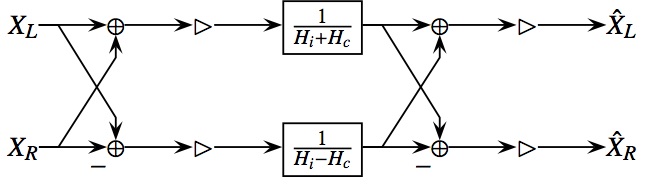
- Get a HRIR using SQLite database and FFT.
- Convolution is computed for every DSP block in Pd (64 samples by default).
- Fresh interpolations are performed only if the location of the virtual source is changed.
RESULTS
- Left outlet outputs the convolved signal for the left loudspeaker
- Right outlet outputs the convolved signal for the right loudspeaker
- See a set of binaural recordings made with this object here:
Reference
-
J. Villegas and T. Ninagawa. Pure-data-based transaural filter with range control. In Proc. 5th Int. Pure Data Convention, Nov 2016.